Have you noticed an increase in text messages and mobile engagement? Whether it’s Macy’s, Kohl’s, or simply your family’s dentist, it seems like companies everywhere are using mobile engagement and communications strategies based on Short Messaging Services, or SMS.
There are several types of SMS, including iMessage and Rich Communication Services (RCS). Regardless of the type of messaging, get ready to receive more communications from companies and agencies via text message in 2026. The why is found in recent research from SAP Emarsys’s 2025 Customer Loyalty Index, which surveyed 10,000 consumers across five different countries, showed SMS marketing as a close second to email marketing in terms of usefulness. In late 2025, email and SMS company Sender found that SMS open rates averaged around a 98% open rate. And Business Software and Services Reviews leader, G2, found in original research of their own that consumers were open to hearing from brands several times per week via SMS.
Meeting Job Seekers Where They Are
With all signs pointing to conversational commerce’s rise in the communications world, we invited Engage by Cell’s Senior Mobile Solutions Consultant, Max Schelkopf, to be our guest on Geographic Solutions’ Marketplace webinar series to get to the bottom of the impending text communications revolution.
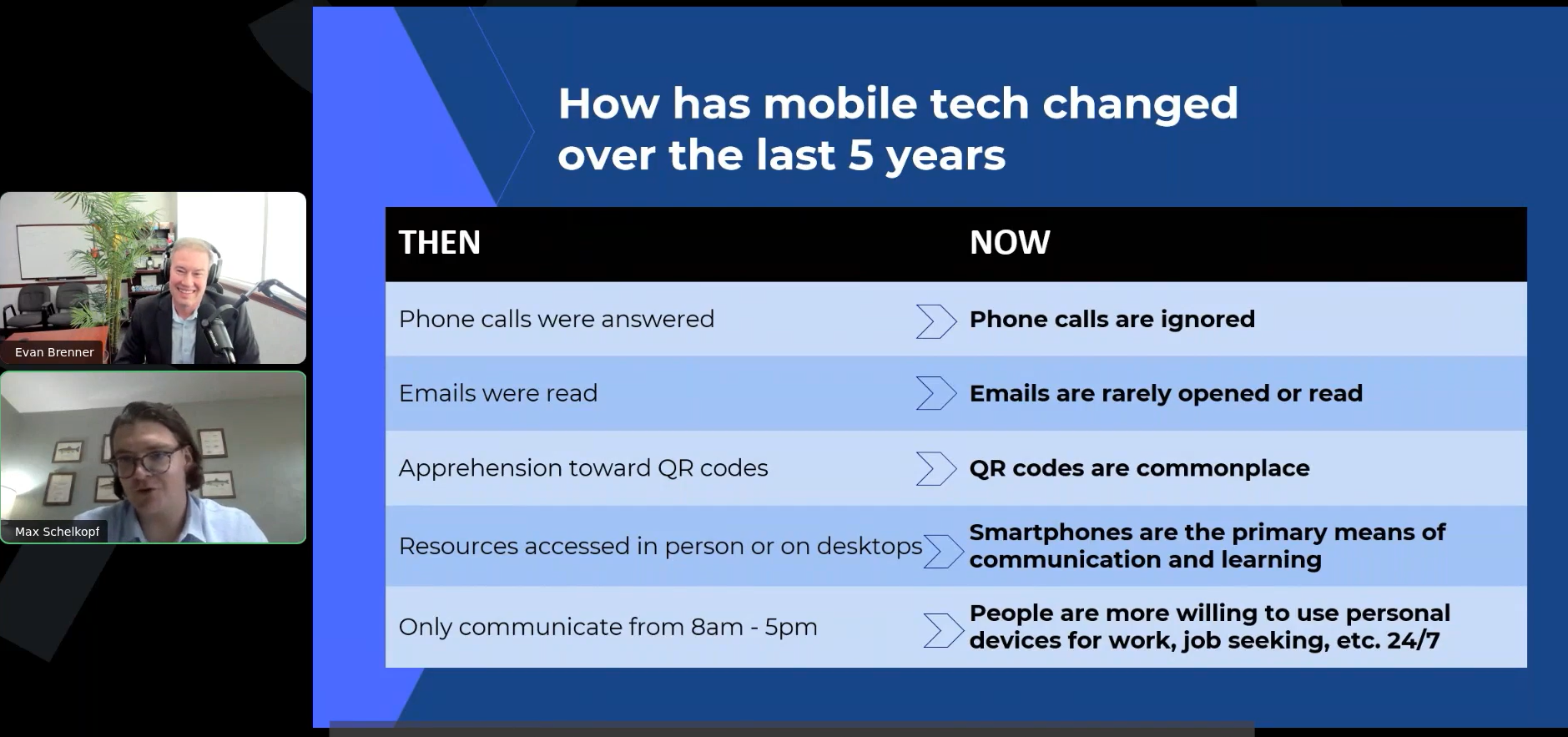
Great communications in workforce development are key to building successful relationships with job seekers and employers. Some of the biggest challenges for professionals in the workforce development field are overcoming engagement and information accessibility barriers.
“For years, the outreach toolbox has been limited to email and phone calls, but engagement with emails has dropped significantly,” said Schelkopf. “Most of us have tens of thousands of unread emails sitting in our inboxes, and, if we don’t recognize the number, we let it go to voicemail.”
The challenge of engagement is significantly diminished when using a communications tool like Engage by Cell. While email is still a strongly favored way to communicate, this communications avenue typically faces a 20%-or-less open rate. Based on the research previously cited in the opening paragraph of this article, text messages offer the best chance that someone will read and interact with your message at 98%.
 What about the second challenge of information accessibility? “Workforce systems are filled with incredible programs and resources, but often have resources scattered across websites, paper, and in-person career centers,” said Shelkopf during the Marketplace webinar. That complexity can be simplified by using a platform like Engage by Cell.
Client Spotlight: U.S. Virgin Islands
When the U.S. Virgin Islands (USVI) Workforce Development Board needed an efficient way to communicate with job seekers, manage client interactions, and share critical workforce information across multiple programs, they contracted with Engage by Cell. Using their platform, in conjunction with VOS Sapphire AI+, they’ve been able to communicate directly with clients, enabling case managers to engage in two-way conversations with job seekers. To date, they’ve sent 56,000 SMS messages, working in partnership with Metrix Learning and Workforce180.
“In the Virgin Islands, we’ve utilized it for everything from hot jobs to events and workshops. It’s such a versatile way to engage the community,” said Mike Fazio, Co-President of Metrix Learning and Workforce180.
By adopting two-way texting, the USVI’s Workforce Development Board has been able to streamline communications and improve engagement across its workforce programs.
SMSing into the Future
The texting revolution is already happening, and in 2026, more workforce programs will adapt to mobile engagement strategies. With the goal of most workforce development programs to create the fastest possible pathway to employment, text communication can be an especially effective channel – offering timely contact, greater accessibility to resources, and consistent engagement across the entire system.
Check your texts and buckle up for more mobile engagement in 2026!